



Can NMN turn back the clock?
'NMN', known as the best nutrient for maintaining youth
The relationship between NMN and NAD+
As we age, levels of NAD (nicotinamide adenine dinucleotide) within our cells tend to decline.
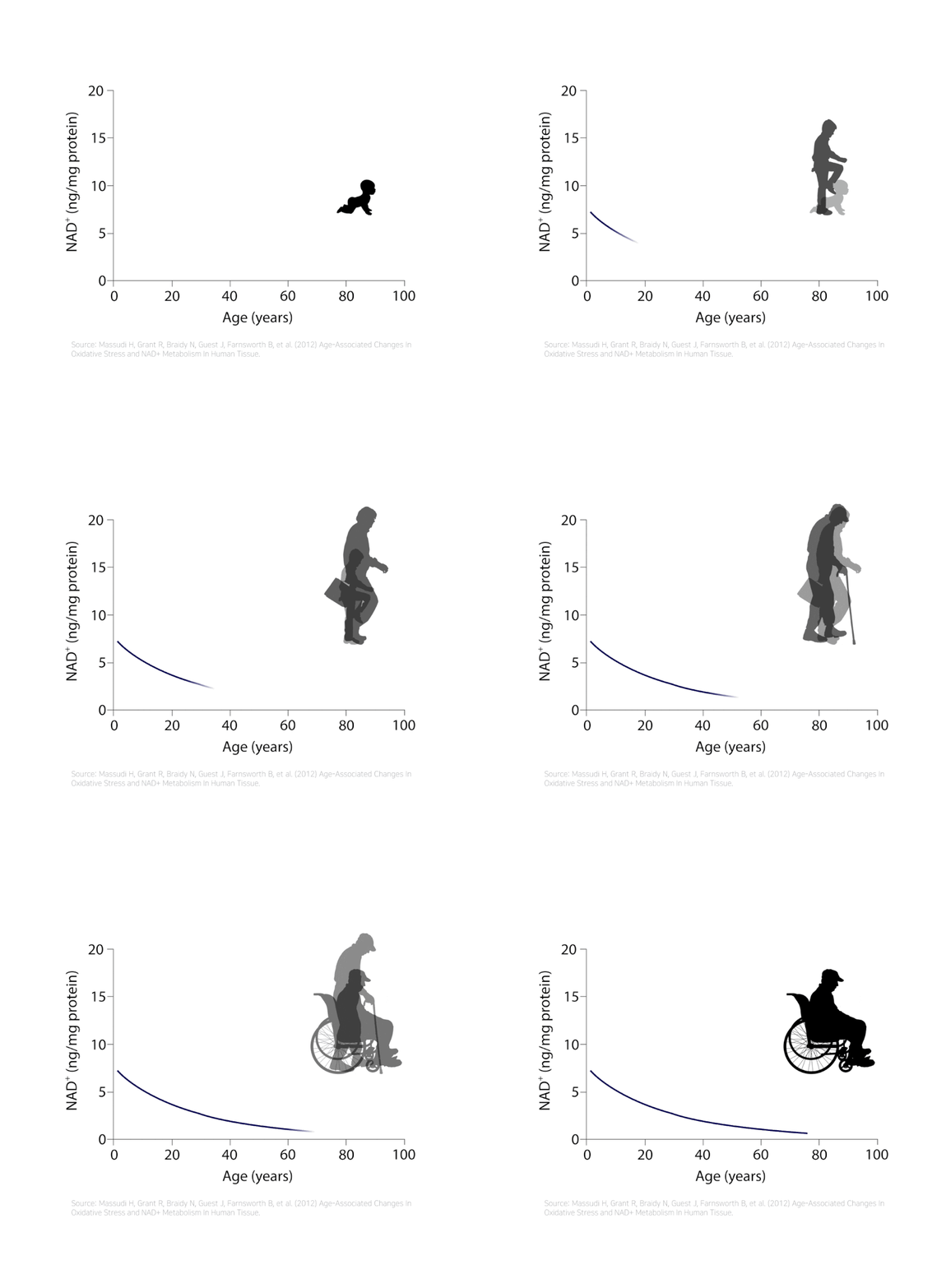
NAD is a molecule that plays a crucial role in several biological processes, including energy metabolism. As we age, decreasing NAD levels are associated with a decline in overall body function and are considered part of the aging process.
So, could we slow down aging by mitigating the decline in NAD levels?
One of the most recent hot topics in research related to the decline in NAD levels that occurs with age is NMN (nicotinamide mononucleotide) . Some studies suggest that NMN supplementation can increase intracellular NAD levels and mitigate age-related decline.
So, can taking NMN make you look younger than your actual age?
Let's take a look at the biological age measurement results of 34-year-old 'Challenger A' who has been taking Rocket America's NMN Pterostilbene product for 8 months .
· NAD KIT used to measure cellular age (biological age): JINFINITI's INTRACELLULAR NAD® TEST
· Actual age: 34 years old, male
· Rocket America NMN Pterostilbene for 8 months
Nicotinamide mononucleotide (NMN) is an orally bioavailable NAD+ precursor that has demonstrated beneficial effects on aging and age-related diseases.
Preclinical studies have shown that taking NMN to increase NAD+ levels, which gradually decline with age, can improve aging diseases such as obesity, diabetes, heart failure, stroke, kidney failure, and Alzheimer's disease by converting it into NAD+ in the body.
Intracellular NAD™ (ICNAD) results for 'Challenger A'
The intracellular NAD™ levels of 'Challenger A' 36.0 μM is 90.0% of the lower limit of the optimal range (40 μM) and 36.0% of the upper limit of the optimal range (100 μM), and falls within the suboptimal range . However, this is the NAD range based on teenagers, and there are intracellular NAD ranges for various age groups.
Intracellular NAD across different age groups
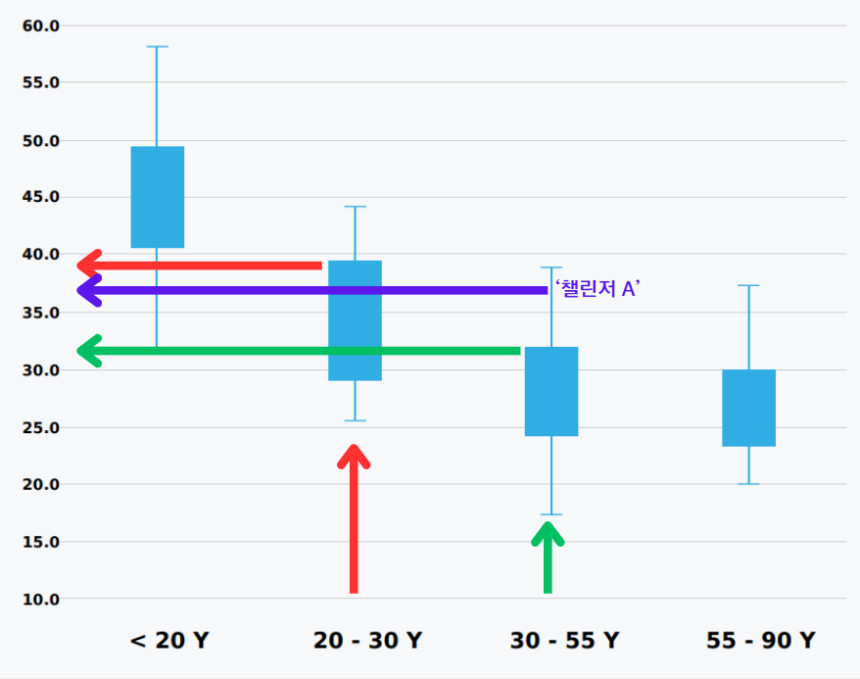
In the graph above , NAD levels in people in their 20s and 30s typically reach a maximum of 39. The NAD level in people in their 30s to 50s is up to 32. Considering the degree of NAD, 'Challenger A' showed a high level of 36.0μM. It corresponds to a stable level even in the intracellular NAD (icNAD) range of 20 to 30 years .
Although classified as suboptimal, considering the high optimal range of NAD in teenagers and the decline in NAD levels with age, 34-year-old 'Challenger A' is showing a positive state with significantly higher NAD levels compared to his peers.
|
range |
division |
detail |
|
> 100μM |
Too High |
Too high |
|
40μM - 100μM |
Optimal |
Optimal |
|
30μM - 40μM |
Suboptimal |
Not optimal, but a good alternative |
|
20μM - 30μM |
Deficient |
lack |
|
0μM - 20μM |
Severely deficient |
severely lacking |
What is the optimal NAD range?
Because NAD levels decline with age, we defined the lower limit of the optimal range using NAD levels observed in teenagers . The 25th percentile of NAD in this age group is 40 μM. This means that 75% of teenagers have NAD levels greater than 40 μM. Therefore, we set the lower limit of the optimal range at 40 μM, which is the minimum level that should be achieved for healthy longevity. While this value may vary from person to person, current research suggests that levels in the 50-75 μM range are a good target.
How to measure intracellular NAD?
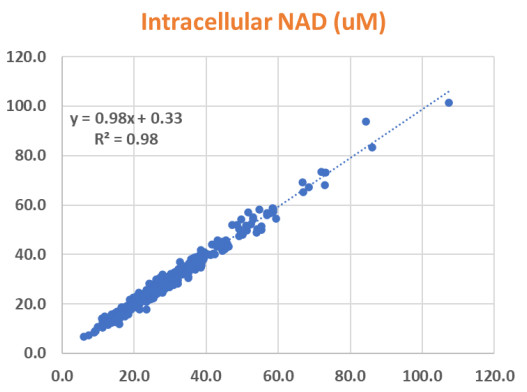
The intracellular NAD assay, which utilizes a high-throughput, accurate, and highly reproducible NAD stabilizing buffer that slows NAD degradation at ambient temperatures, is highly reproducible, as shown in the correlation graph of duplicate tests performed on samples identical to consumer samples. This technology enhances reproducibility by allowing duplicate results even when samples identical to consumer samples are prepared. You can see the clustering of blue dots in the table below. The average coefficient of variation is 3.1% and the correlation coefficient (R2) is 0.98.
- Reproducibility: Observing whether the results reported in the original study are (almost) identical when the study is repeated again.
- Coefficient of variation: The standard deviation divided by the mean. A higher value indicates a more spread-out data distribution.
- Correlation coefficient: A coefficient that numerically represents the degree of a specific correlation to express the statistical relationship between two variables.
Benefits of Optimal NAD
|
Benefits of Optimal NAD |
Increases cellular energy (ATP) |
|
Increases endurance and strength. |
|
|
DNA repair capabilities are enhanced. |
|
|
Oxidative stress is reduced. |
|
|
Improves your ability to fight inflammation. |
|
|
Bone density improves. |
|
|
Reduces cellular aging, such as cardiovascular disease, cancer, diabetes, infectious diseases, and neurodegenerative diseases. |
|
|
It improves immunity. |
|
|
Improves brain cell repair and protection. |
|
|
Improves glucose intolerance and insulin sensitivity. |
|
|
Plasma lipid profiles are improved. |
|
|
The production of nerve tissue is improved. |
|
|
Prevents age-related diseases. |
Risk factors for NAD levels
A variety of factors can cause low NAD levels.
|
Risk factors for NAD levels |
Age (NAD decreases with age) |
|
low physical activity |
|
|
genetic and epigenetic defects (NAD synthase) |
|
|
Disease and suboptimal health conditions |
|
|
alcohol consumption |
|
|
nutritional deficiencies (vitamin B3, tryptophan) |
|
|
Aging and Inflammation (CD38) |
When should I retake my NAD test?
The iCNAD test result only reflects the NAD status at the time of blood collection. Because Challenger A's NAD status fluctuates with age, external and internal changes, and NAD supplement intake, it's important to retest your NAD regularly.
If your NAD levels are in the optimal range and there have been no significant changes to your lifestyle, nutrition, health status, or how you get NAD, we recommend retesting in 3 to 6 months .
If your NAD levels are not within a healthy range, consider taking steps to increase your NAD levels and then retesting in 2 to 4 weeks. Typically, 2 to 4 weeks is sufficient to increase NAD levels.
To maintain the current NAD level of 36.0 μM or increase the NAD level further , we recommend that 'Challenger A' continue to maintain a healthy lifestyle and nutritional management in addition to the NMN he is currently taking .
Rocket America will continue to strive to answer all of your questions.
We will continue to provide you with useful content by collecting various health information.
thank you!
[References]

© All rights reserved to Rocket America. Any unauthorized use is prohibited.
#nmn #nmnefficacy #nmnreview #rokitamerica #nad #nadlevels #nmnendofaging #nmnsupplements